
Essay: Jazz – A Love Letter to Ken Burns
While many kids rebel against their parents with Marilyn Manson tucking his dick between his legs and a goofy makeup phase, I’d already seen him in concert when Antichrist Superstar dropped. I was on that train in 1994 with Portrait of an American Family. I was into punk and heavy metal music when I was young, thanks to skateboarding. A Metallica or Slayer shirt was not uncommon at my mom’s house by the age of 12.
My form of rebelling was dudes in suits playing music my parents wholly did not understand. Listen to Black Sabbath or Hatebreed, no one in my familial home bats an eye. Get into Duke Ellington, suddenly, you’re the weirdo. My dad rides a Harley. Meanwhile, I’m finding meaning in Sylvia Plath’s The Bell Jar.
My parents are cool. My mom’s favorite band is Alice in Chains. My dad told me who GG Allin was – “a guy who would rub shit on himself.” So, you have to find your own moments. I did that with books, art, food, and music. Jazz was a first step into a larger world, as Obi-Wan tells Luke Skywalker.
There are few times in life when you can look beyond the existential husk and know, “fuck, I love this,” while something is happening in real time. Someone didn’t turn you onto it; you found the water yourself and chose to dive in. Getting wet was the point. That was me with Jazz, Ken Burns’ 2001 documentary on the history of the music.
PBS is a motherfucker.
I was 19, enrolled in writing classes at my local community college. I was not a good student. I was just starting to realize that old country music like Willie Nelson wasn’t Toby Keith, that the blues I grew up with was actually cool, and that everything didn’t have to be fast and screaming. That said, At the Drive-In had released Relationship of Command, and Refused’s The Shape of Punk to Come was out, along with a steady diet of trip hop and Radiohead – my mind was primed for music that wasn’t old Sepultura. Everything was starting to open beyond what my friends liked, what shirts I saw guys in bands wearing. I had given myself allowance to seek.

I do not come from a gilded life. I’m from the South Side of Chicago. My family works in the trades. My dad loaded trucks. When I realized I wanted to be a writer, that was a lesson in self-discovery because, baby, it’s a fool’s errand. But diving into those Beat books, Bukowski too, I wanted to explore inner worlds; jazz felt like a natural bridge to those feelings. It felt cool because it was decidedly uncool – who the fuck is listening to Billie Holiday in 2001 where I lived? Lemme tell you, nobody. Her music has stayed with me. “In my solitude you haunt me” is one hell of a way to open a song. It felt like unlocking a crypt inside myself but also stepping into a larger, weirder, darker universe. I was buying the books I heard people I thought were cool talking about in interviews. I did not know who Charlie Parker was when I saw his name in whatever book I was reading at the time.
But with sonic doors creaking open, I bought into what Burns made – hook, line, and sinker. Being an NPR/PBS nerd, I randomly came across the documentary at an age when I was figuring out that wanting to be a writer was cool, that art was cool, and that liking interesting things was cool. Louis Armstrong’s horn made sense. I think it was a Sunday night. It was a night when I wasn’t out; I was lying in my bed, a bleak teenager. But a teenager who liked public-broadcasting documentaries.
Sitting in my bedroom at my parents’ house, walls covered in posters of Snapcase, Nirvana, random political causes because I’ve been a lefty since the jump; eg., wearing a Free Leonard Peltier shirt since the 90s, or having photos of Howard Zinn and Noam Chomsky up next to Picasso prints – I was a lot. I am sorry if you knew me at my most insufferable. I had sheets tacked up over the blinds to keep the sun out as much as possible, because what are blackout curtains to a kid?

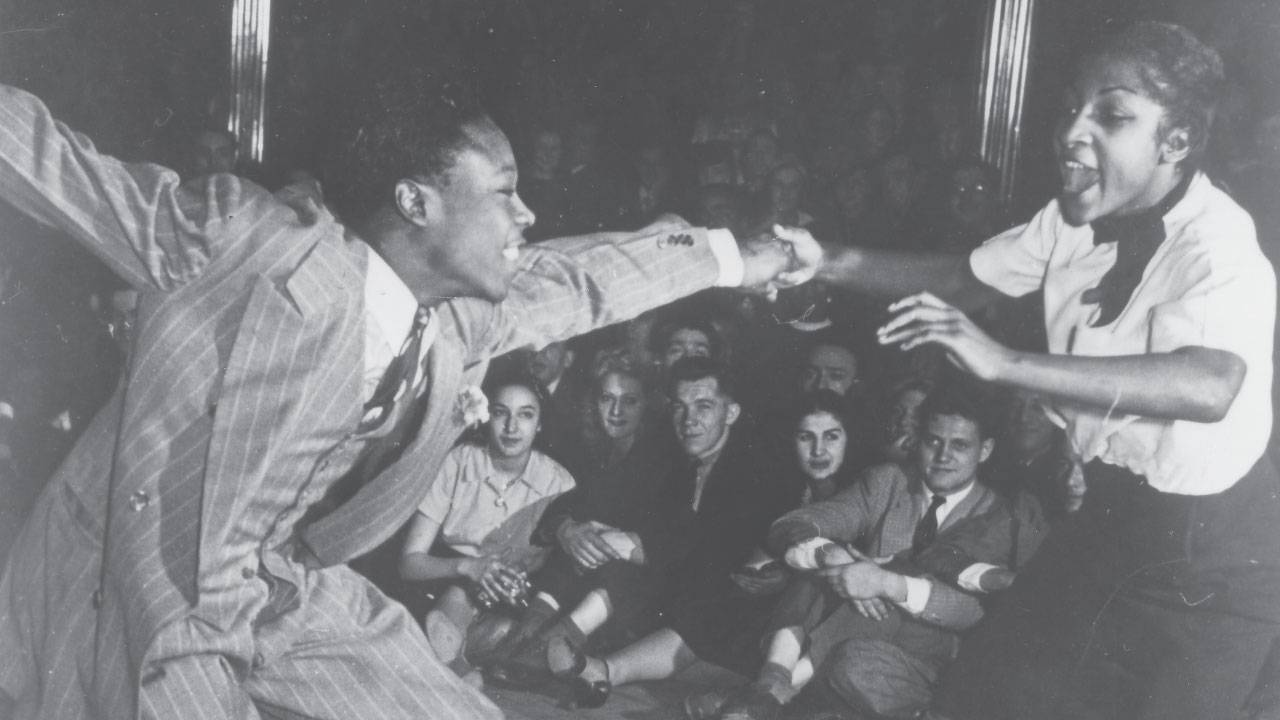
I remember stumbling on the show, seeing photographs of legendary jazz players move over the generations, seeing black-and-white footage of Dizzy Gillespie, of Minton’s Playhouse, the smoky black-and-white images, thinking, “these motherfuckers are cool as hell.” I was transfixed at the end of my bed, staring off as the narrative took me to places I fell in love with: New Orleans, New York, Europe; the stories of those folks willing to forge themselves in the flames of change felt like something I could grasp. Yes, I wanted to learn about how Miles Davis was functionally into heroin but also pimping, and how, clean by then, he improvised the soundtrack to the French noir masterpiece, Elevator to the Gallows, in one night while watching the film.
Burns had built an enormous machine to produce that feeling. Jazz took six years to make and spanned nearly 19 hours, bringing together decades of music, interviews, photographs, and archival footage. Did I know who Ken Burns was? Absolutely not. Did I know who Ella Fitzgerald was? Maybe?
Hearing Armstrong play “Stardust” or Coltrane play the title track off A Love Supreme again, I was so deep into this. Ken Burns had made a fan of jazz for life. This was elevated shit; it was art. And at the time, I was reading books about why people made art, why we should think about it. This jazz shit was like someone painting something new. I loved it.
A Grand Noise

There’s a scene in the documentary where the great jazz historian Gary Giddens talks about the time he played Armstrong’s version of King Oliver’s “West End Blues” for a colleague. The guy asked him to play it again, citing, “this is probably the most perfect three minutes of music I’ve ever heard.” And he’s probably right. There’s something eternal about that recording of “West End Blues” that works a century later. You could play it over the highlight reel of anyone’s life, and it would fit, all in less time than it takes to microwave a Trader Joe’s burrito.
“West End Blues” cracks open with Armstrong alone, no band, just that horn running up and tumbling back down like he’s clearing his throat to tell God a tall tale, just between friends. Then the band eases in slowly, a blues with nowhere to be. Later he sets the trumpet down and sings back and forth with the clarinet, no words, just scat, two guys finishing each other’s sentences. Earl Hines takes the piano and makes it sound like it’s falling down a flight of stairs on purpose. And then Armstrong comes back, climbs to one high note, and holds it, and holds it longer than seems sane, before the whole thing settles back into the blues and shuts the door behind it. At 19, I knew it was impressive. At my age now? “West End Blues” is the heart of pure brilliance. That’s one of those records that could be locked away in a catacomb, and someone in 100 years could find it and think about human achievement.
Those kinds of songs always get me; it’s like my favorite song of all time, “I’m So Lonesome I Could Cry” by Hank Williams. A good song can transport you into someone else’s experience. For those few moments, I think Louis Armstrong has his own body-switching machine surging through his horn; the question isn’t how powerful, but how tuned in the people listening are.
Cutting Contest

If you ask me, jazz is the music of seeking rather than saying. With the music of Hank Williams, he’s explicitly saying something, laying it down for you, for your head and heart. It’s obvious when you’re sad over a long neck. When Monk does the nasty at the piano, that’s an exploration in chaos. That was something I had to live with, think about, and not just automatically give myself to it. I didn’t have the emotional language to describe hearing jazz. No one in my life listened to it. I was not raised with Ivy League scholars who happened to throw on a little Edith Piaf to add some color to the mood. Instead, my people love to sit in the garage and soak in Grand Funk Railroad. My parents didn’t have a language for this kind of freak flag; Black Flag is easy. It’s just loud rock and roll in the form of speed, blood, and violence.
I’d plan my schedule around the air dates of episodes. Apparently, a ridiculous number of people were watching alongside me. Jazz averaged 10.3 million viewers a night during its original PBS run. I felt like I had found a dirty little secret because no one in my life was watching. Everyone I knew loved Pantera. Nobody wanted to get into the weeds of the impact of Jelly Roll Morton ticklin’ the ivories. I could ask my old man how to fix a flat tire or the p-trap under the bathroom sink. I couldn’t ask him about Monk.
Because now things are so easy to stumble into with the internet, maybe this one means more to me. Still, I think when you make a discovery despite the algorithm, it’s more impactful. I also think those moments of self-discovery mean more because they’re pure – you see a movie late at night by John Waters. You realize, “this dude is weird. But I’m into this.” And boom, you’re watching Divine eat shit in Pink Flamingos, and it’s not just a movie; it’s something you’re telling the homies about, and you feel like you’re sharing this secret.
Burns’s series famously rushed and dismissed free jazz. The series gave me a canon, a knowledge of what to look for, even if I wasn’t totally sure about the genre then. I knew I liked bebop and dove into the music from there. Do I understand free jazz all these years later? On paper, sure. In practice, I know it ain’t for me. Sorry, John Coltrane’s weirder records.
An Unexpected Path
I think getting into jazz opened creative doors. At the time, I was still playing in hardcore bands. But I was trying to challenge how I thought about riffs, how I could get a swing going but heavy. I was moving away from GED caveman riffs and getting more into ways to make something like what Radiohead would play, but make it super gnarly. I think getting into jazz gave me the language to do that with confidence: “What if I tried to play with a groove that wasn’t as predictable?”
Liking jazz is what led me to bands like Candiria and the Dillinger Escape Plan, two bands that were deeply experimental in their time signatures and sound. I tried to play more off-timed riffs. I tried to think, “How would Candiria play this?” The problem was that I was good at guitar because I was good at playing groovy Pantera riffs with the chug; chasing the dragons of how Charlie Parker would write a mosh part didn’t work so well for this kid. We did manage to lift some of the secret sauce from what the guys in Refused were doing, so maybe siphoning that “New Noise” magic worked, as they got their vibes from Ornette Coleman.
When Everything Goes Boom
Burns does what Burns does, walking through the history books of John Coltrane, Dizzy Gillespie, and Sarah Vaughan. Inside his world, the viewer is transfixed by the audible chaos of the movement from swing into bebop, and we’re left holding our breath. I’m this young kid, fresh out of high school, thinking he’s hot shit with his books written by Burroughs and Ginsberg, watching these old cats like Gary Giddins and Stanley Crouch, not realizing till many years later that these dudes talking may not be as famous, but they were bad motherfuckers when it came to writing.
Crouch especially wielded a pen that could stab you in the neck and never run out of ink. Years later, when Crouch was named an NEA Jazz Master, he thanked everyone who had spent time in clubs and concert halls pursuing “the essence of jazz, which is the feeling itself.”
These writers of that jazz era were dawgs with their razor-sharp observations of how the music changed the rules of groove. They explain with such clarity that these musicians out there grinding every night in the clubs are daredevils, that they’re going for it, trying to lead the rest of the band across the Styx and up into where the fuck Dante feels like going.
Bronzeville

I never realized how central my hometown of Chicago was to the expansion of jazz. Back then, I thought the city was the center of the universe; now that I’ve been a lot of places, it’s a pang of pride when I see us come up in the books for being on the right side of history when so often many locales are not.
Jazz made me feel like I understood Chicago’s Black culture better. It made me realize how little I understood about Black Chicago beyond the world directly around me. I shopped next to Black people. I went to school with them. But proximity isn’t the same thing as understanding someone else’s culture, history, or experience. Up until then, a lot of what crossed those lines came through whatever pop culture gave us as a shared moment — a rap song, a movie, something everyone happened to know at the same time.
Jazz made me want to go deeper. It made me want to read the writers of the Harlem Renaissance beyond the gloss-over we got in high school, to understand where this art came from and what else I had never bothered to look for. It made me want to understand the blues more, too. I had grown up loving that music, but mostly as sound — as the thing that fed rock and roll, the old Black dudes with guitars who clearly knew something everybody after them was trying to steal. Ken Burns’ Jazz made me realize how shallow my understanding was.
These weren’t abstractions or genres sitting neatly next to one another in a record store. There were histories underneath them — migration, segregation, churches, neighborhoods, poverty, joy, invention, survival — and those histories mattered. A lot. I wanted to see beyond the South Side stereotypes, see where the Checkerboard Lounge used to be, walk through Bronzeville, or eat at Pearl’s Place off Pershing Road, the old Ritz Hotel where Duke Ellington used to stay.
It was one of the first times I understood that the bubble of your own personal world needs to be popped. For me, jazz became an academic but emotionally intelligent way to look beyond the usual stereotypes and beyond the platitudes of punk telling me I wanted a more just world.
Wanting a better world is one thing. Actually trying to understand more of it is another.
Straight, No Chaser
 I know we all took little bits and pieces from one another like rags floating in the ether, and that was always the cool thing about my crew: everyone stole from one another.
It’s why I love Joy Division, Depeche Mode, and Nine Inch Nails; I got that stuff from my friends as I gave them Earth Crisis, the Ramones, and probably Birth of the Cool. Maybe taste is communal, even when it’s personal. Maybe the art we lay ourselves at the feet of can be something we share, even if it’s later down the road.
Soon, I was buying CDs by Sidney Bechet and Dexter Gordon and making stylistic notes about how the look of the classic Blue Note releases made me feel. I fell in love with the style of those covers, the deep blues and greens; they were so much more artistic than the rock and roll covers. They’re still an aesthetic I love. Reid Miles’s typography, Francis Wolff’s photos.
The jazz aesthetic is omnipresent in my life. I wear sunglasses modeled from the 1950s. My hairdo is as classic as it gets, complete with a side part. I love old fonts, hand-painted things, classic, clean design. I would rather die than wear anything Kanye West designs. Neon-colored anything repels me.
I think somewhere in my lizard brain jazz helped make New Orleans more alluring. In this place I eventually moved to, there were secrets. I thought of it as a spiritual home. I was correct. Call me a romantic.
There is a memory that’s forever lodged in my brain: I would walk from my house in Tremé, the neighborhood that gave us jazz. I’d cross into the Quarter from Rampart, hearing the bands the closer I got toward Bourbon. Some nights, I would sit up by the Mississippi and hear the bands playing on the steamboats for the tourists – the same kinds of rigs that Mark Twain used to pilot and Louis Armstrong used to play. I also walked past Doreen Ketchens, who played with her band on Royal Street, coming as close as one can get to ripping the roof off the sky.
And by the end of my stay in New Orleans, I’d walk past the street musicians, leaving them to their work as I hustled to get to mine on the notorious Bourbon. Now, when I go back to visit, I’m often tempted to stop and listen to the bands playing. That experience has come full circle.
I don’t feel I have ownership of the music. But what I have now is identity: those tunes, the music, the chaos, loving this old-school stuff, whether it’s the Carter Family or Max Roach, I’m still finding that 19-year-old kid in the mix.
I now donate to PBS monthly because I’m old and need to keep it on the air for the next kid.
Thank fuckin’ God for Ken Burns.
Featured image courtesy of PBS


You must be logged in to post a comment.