
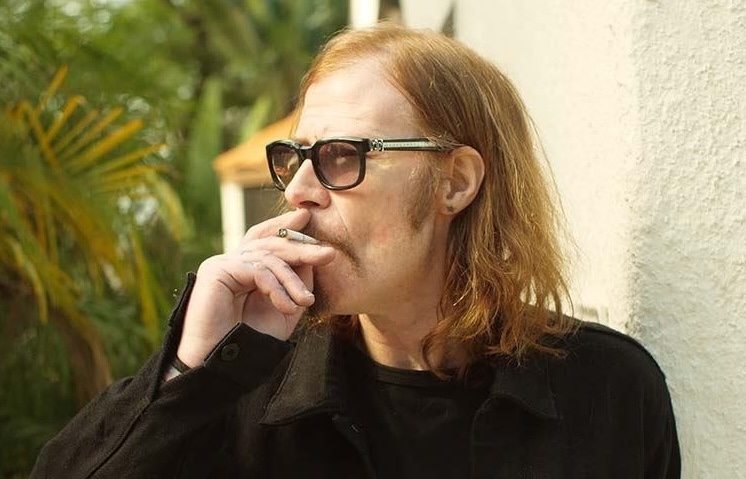
Opinion: Mark Lanegan should be in same conversation as our greatest songwriters
Recently, I was battering away on a piece in my local coffee shop (shout out to Epoch) and wasn’t in the mood to wear my headphones. Usually, the music is weird and interesting as all late-night artist-friendly coffee hangouts tend to be – what plays in Epoch has no rules, it’s whatever the baristas are feeling for their shift and that shit can be weird. Whoever was working that day played Jeff Buckley’s entire Grace album and, having not heard it for years, I gotta say, I absolutely hated it.
I get that Jeff Buckley is beloved. I know people with tattoos of his lyrics. Listening to it, I was taken to a place of feeling like, it was too dated for me, that I felt like people loved this record for its mythology of Buckley dying young and tragically more than the actual musical weight of the record, that his cover of Leonard Cohen’s “Hallelujah” made him so deep. It got me thinking about hype, legacy, and ultimately, Mark Lanegan.
I know we’re supposed to revere Buckley for his songwriting prowess, the “what if” that surrounds the singer due to his accidental drowning in the Wolf River. This got me thinking about mythos and how we raise some artists to this coveted place of the holy—that the art they create is something more than notes in succession, but gifts from the beyond.
This isn’t a shit on Jeff Buckley fest. We culturally do this to all kinds of artists gone too soon: Hank Williams, Kurt Cobain, Jimi Hendrix, and Dimebag Darrell. Dying young gets you canonized while dying like an old whore, has its price tag against god. Survival changes myth, just as Patti Smith or HR from The Bad Brains.
Legacy is important in music. I often wonder where Mark Lanegan fits into the ether of those spirits of rarified air—singers like Leonard Cohen, Tom Waits, Nina Simone, John Prine, Patti Smith, Björk (Fight me on this one), and Nick Cave. Lanegan’s body of work is certainly artistic, it’s also wildly diverse: from his days with Screaming Trees, to his work with Queens of the Stone Age, to a solo career that felt like a witch’s nail carving names into granite.
Born in Ellensburg, Washington, Lanegan came up in the grunge era with Screaming Trees, but unlike Nirvana or Pearl Jam, he never broke into the mainstream, he stayed on the shadowy edges, carving his own path. He was a cult hero rather than a guy plastered on Target t-shirts for middle aged dads to wear to feel cool despite their crocs and khakis.
For the uninitiated, Lanegan’s voice sounds like a sandpaper-wrapped wolverine, it’s smoky, bluesy, but not like a lounge act. Instead, it’s rife with the possibility of murder. As Tom Waits has moved through musical categories over the years, it’s easy to see how he’s considered an icon. Lanegan, for his crimes, gave us lyrics like these:
“Love, is the medicine good?/Is the crow flying eight miles high/Over wire and wood?/ Shovel down six feet/With a head heavy pain/The magnolia blooms so sweet/And it fades just the same.” – The Gravedigger’s Song
Depth like that feels like something carved into an urn while we’re out here thinking Jim Morrison is this genius poet, when instead, he died a fat guy in a tub. Lanegan’s legacy is that of someone who gave us brutal honesty into his troubled, battle-scarred life with no remorse.
Revered as a “post-grunge grim reaper” with a “corroded growl,” Lanegan carved out a career that outlasted many of his peers who burned out or faded away. While the grunge wave claimed some of its brightest voices, Lanegan kept pushing, turning his scars into songs that blended blues, folk, and gutter-level rock. His influence runs wide—echoes of his style seep into indie ballads, Americana laments, and the darker corners of alternative rock. As Pitchfork noted, he became a touchstone for artists across genres, proof that survival and reinvention can be as mythic as dying young.
Between 1990 and 2020, Lanegan released 12 solo studio albums. Some of the more notable works include—The Winding Sheet (1990), Whiskey for the Holy Ghost(1994), Bubblegum (2004), Blues Funeral (2012), and Straight Songs of Sorrow (2020).
Lanegan’s career was never about staying in in a single musical lane: he thrived on collaboration, whether it was the spectral folk duets with Isobel Campbell or the ragged soul grind of The Gutter Twins with Greg Dulli. Those projects, along with his work in Queens of the Stone Age, cemented him as a kind of connective tissue linking grunge’s collapse to desert rock’s swagger and Americana noir’s fatalism.
His memoirs, Sing Backwards and Weep and Devil in a Coma, extend that same brutal honesty—dispatches from someone too jagged, too unmarketable, maybe too scarred to ever be canonized alongside Waits or Cohen. Some people can’t handle candid speak about pawning Kurt Cobain’s guitar or bopping in the shadows, almost dying multiple times from cheap smack.
I put on his records Bubblegum and Blues Funeral as I write and feel like I’m crawling out of a hole where the light of God can’t be felt. For me, his music has served as a soundtrack on late-night drives when everything is fucked, or when I was the lone screw-up in the bar, a cinematic moment. These are shared traits with the master Waits, to be the bard of the barroom. And Lanegan gives us that same twisted magic.
No one knows how Mark Lanegan died. We just know he did. His family has kept it private. So you make your own assumptions. Death in Ireland by way of the bleeding artist-poet, kinda beautiful. Too bad now, the demon in his voice only lives on tape.
Depth, artistic sensibility, diversity, good, poetic lyrics, all of it is there and imprinted upon the DNA of his music. Where does cult respect and interesting character meet? In this case, I believe the music of Mark Lanegan speaks for itself, it washes ashore of chaos, grief, and understanding through a broken lens of the world, which is exactly what we want in an anti-hero.
So why isn’t Lanegan canonized like Cohen, Waits, or Buckley? Who gets saint status? Maybe he was too jagged, too unmarketable, too scarred. But maybe that’s the point—his legacy is less about sainthood and more about survival, about being the gravel in the gears of modern rock. His sins were carved into every phrasing of his music, he died on the cross of a hard life. Jeff Buckley gave us “what if” Mark Lanegan gave us “what it is.”
Featured photo courtesy of Mark Lanegan


